A client in Manchester opened my proposal once, read it, and never wrote back. I checked the tracking out of curiosity. Forty seconds.
For months after that I blamed my rates. They weren’t the problem. What I’d sent him was fourteen lines about what I could do, and not one thing he could go and check for himself. He wasn’t turning down my work. He had never seen my work.
That’s the actual reason it’s hard to get international clients from India. Not skill. Not price. And really, truly, not your accent.
The three-step version:
- Show, don’t claim. Live projects a client can open, not a list of services.
- Write clearly and tell the truth. Especially about the things you can’t do.
- Convince, don’t discount. The close gets easy once the first two are sorted.
There’s a fourth thing nobody warns you about, and it quietly costs real money. I’ve put it at the end, because it only starts to matter after someone says yes.

Step 1: Replace “I Can” With Something That Opens in a Browser
Open almost any freelance profile from India and you’ll find some version of this: I can do WordPress, I do SEO, I can build landing pages.
Now read it the way the client reads it. It’s a promise about the future, made by a stranger they met eleven minutes ago, in wording they’ve already seen forty times this week. Nobody’s doubting your skill here. They just have nothing to go on.
So hand them something to click. This is the single biggest shift for Indian freelancers chasing international clients, and it costs nothing.
- Pick three things you’ve actually built. A client site, your own blog, a practice build from last month. Whether money changed hands is nobody’s business. It only has to load.
- Write one plain line under each. Not “increased traffic massively.” Say what you did: “Rebuilt this on WordPress, moved the enquiry form above the fold, here’s the live page.” Modest and checkable beats impressive and vague.
- Put all three on one page on your own domain. Email at the bottom. Not a PDF. And please not a Drive link that makes them request access.
You’re standing inside my own example right now. The site you’re reading this on is one of my projects, built on WordPress and grown with the same content and SEO work I do for clients. When someone asks what I actually do, I send them this URL instead of writing a paragraph about myself.
Something shifts the moment they’ve clicked. The conversation stops being about whether you’re real, and turns into a conversation about their website. Every deal I’ve closed crossed that line first.
Built nothing yet? Make two small things this month and lead with those. In years of doing this, not one person has ever asked me whether a demo had a paying client behind it.
Step 2: Your English Doesn’t Need to Be Impressive. It Needs to Be Clear.
Most people worry about the wrong half of this. Your accent doesn’t matter, because almost the whole relationship happens in writing and nobody can hear you on a Slack thread. Vocabulary barely matters either.
What matters is whether a tired client, reading at nine on a Monday morning, gets through your message once and knows what happens next.
Four rules I hold myself to
- Short sentences. If it runs past two lines on a phone, cut it in half.
- One idea per paragraph. They’re skimming between meetings, not studying it.
- Answer the question they asked. Not the version you’d rather answer, and not with three extra things they never brought up.
- Rewrite anything that needs a second read. If you have to check your own message twice, they won’t check it once.
A cold email template that actually gets replies
Those four rules are also what a first outreach message looks like when you actually apply them. Short, specific, one link, one question. It works as a cold email template for developers just as well as for designers or marketers:
“Hi [name] — I build and rank WordPress sites, mostly for small service businesses. I noticed your enquiry form sits below three screens of scrolling, which usually costs a chunk of leads. Here are three sites I’ve built: [your one-page link]. Worth a fifteen-minute call this week?”
Sixty words. They can verify me in one click and reply with one word. That’s the whole design.
The harder half is honesty, and it pays better.
When a client asks for Shopify and you don’t do Shopify, say it straight. Here’s my exact wording, and you’re welcome to steal it:
“I don’t do Shopify. I’ll handle the WordPress side properly and can introduce you to someone for the rest. Happy to stay involved on the parts I’m actually good at.”
I know how that reads when rent is due. Send it anyway. So few freelancers say it that clients hear confidence rather than a gap, and I’ve been hired for a smaller scope precisely because I turned down the bigger one.
Overpromising costs more than it looks like it does. A missed deadline doesn’t just lose you the project. It takes the referral they would have made, and the case study you were planning to build out of it.
Pro tip
Send a two-line recap after every call. What you’re delivering, what you’re not, and by when. Nearly every “but I assumed that was included” argument I’ve ever had would have died in that one email.

Step 3: Closing Is Convincing, Not Chasing
Closing gets talked about like it’s a separate talent you either have or don’t. It isn’t a big deal. Once the proof and the communication are sorted, there’s very little left to do at the end.
One habit I’d change in how most freelancers run a sales call: ask about their problem before you mention your solution.
Something plain does the job. “What’s the current site costing you?” Then stay quiet and actually listen. They’ll hand you three things without realising it:
- What to quote. Their answer tells you the size of the problem, which sets the number.
- What to emphasise. Whatever they complain about first is what they’re really buying.
- What the last freelancer got wrong. Free competitive intel, every single time.
Nine times out of ten, they talk themselves into hiring you while explaining it.
Two things to avoid once you’re at the number
- Don’t drop your price when they pause. That pause is rarely about money. Cutting the figure only tells them every future figure is soft.
- Don’t follow up more than twice. Two messages, a few days apart, then leave it alone. The third one carries a tone you can’t hide.
Worth being straight about
This system turns proof into clients. It doesn’t create the proof for you. If you genuinely have nothing to show yet, the next three weeks belong to building rather than pitching.

Where to Find International Clients From India
The three steps work anywhere. What changes is the price of entry, and each channel suits a different stage of your freelancing.
| Channel | What it costs | Best for | The honest catch |
|---|---|---|---|
| Marketplaces (Upwork, Fiverr) | A service fee cut from your earnings | Building your first reviews | The low-budget end is fiercely competitive |
| LinkedIn outreach | Time only | Founders, agencies, B2B services | Invites are capped, so targeting beats volume |
| Cold email | Time plus a domain | Niche services with one clear outcome | Slow to warm up, and mass sending wrecks deliverability |
| Referrals and subcontracting | Nothing upfront | Steady work without pitching | Needs one happy client to get going |
Starting from zero? I’d take a marketplace for the first two or three jobs and nothing else. Reviews are the one thing you can’t manufacture, and every other channel gets easier once you have four of them sitting there.
What Upwork actually charges freelancers
Upwork is where most Indian freelancers land their first international clients, so it’s worth knowing exactly what it takes before you send a single proposal.
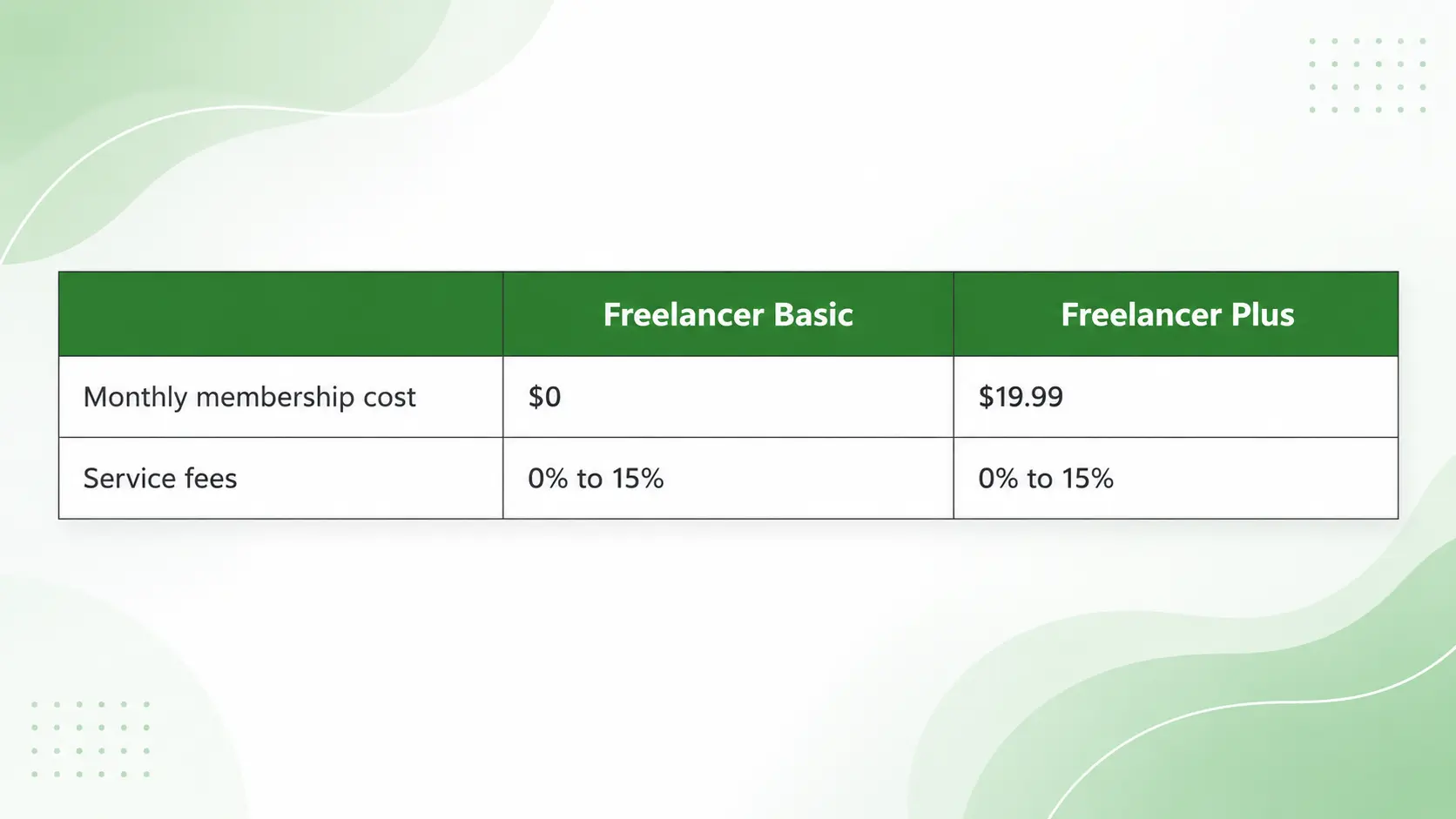
The figures above come straight from Upwork’s own pricing page. We’ve only redrawn them to make them easier to read. Here’s what they mean in practice:
- Freelancer Basic costs $0 a month. It includes 10 Connects a month, the credits you spend to send proposals. Extra Connects cost $0.15 each.
- Freelancer Plus costs $19.99 a month. It includes 100 Connects a month, job alerts, full profile customisation, and a 0% fee on direct contracts instead of 5% on Basic.
- The service fee is 0% to 15% on both plans. Upwork says the exact figure depends on the type of contract and on supply and demand. You’ll see it before you send a proposal or accept an offer, and it stays fixed once the contract starts.
- You pay the service fee only when you get paid. The Plus membership and any extra Connects are charged upfront.
My advice for anyone starting out: stay on Basic until you’ve won a couple of contracts. Upgrade to Plus only once you’re sending enough proposals that 10 Connects a month genuinely slows you down. And since Upwork has changed this structure more than once, treat the number on your own proposal screen as the only one that counts.
LinkedIn outreach for freelancers
After those first reviews, LinkedIn is where I’d spend the time. It doesn’t publish a fixed weekly cap on connection requests, though outreach tools commonly report a ceiling somewhere near 100 a week that moves with account age and behaviour. That’s never bothered me much. Twenty requests to people whose work you’ve actually read will beat two hundred sent blind.
One small thing decides more deals than it should: offer a two-hour overlap with the client’s working day, and say it before they ask. Between two freelancers who look identical on paper, that single line has won me the job.
The Part Nobody Warns You About: Getting Paid Properly
This is where Indian freelancers working with international clients actually lose money. Not on rates. On the mechanics after the yes.
Picking a payment route
| Payment route | How the conversion works | Best for | Watch for |
|---|---|---|---|
| Wise | Mid-market rate plus one transfer fee, per Wise’s own guide | Direct bank transfers from client to you | Your client has to create an account first |
| Payoneer | Its own conversion rate applies | Withdrawing marketplace earnings | Check current withdrawal charges before choosing |
| PayPal | Adds its own currency conversion charge on top | Small, quick, one-off payments | That charge eats noticeably into small invoices |
Rates move constantly, so check each provider’s own pricing page before you settle on one. A table on a blog goes stale faster than you’d think. This one included.
The GST detail that catches people out
Work you do for a client outside India generally counts as an export of services. That’s a zero-rated supply, meaning 0% GST instead of the 18% you’d charge a domestic client. Five conditions have to be met for that treatment, and one of them trips people up constantly.
The payment has to arrive in convertible foreign currency.
If a US client pays you in rupees, through UPI or an Indian bank transfer, that condition fails and the work stops qualifying as an export. Suddenly you’re looking at tax on income you’ve already spent. So insist on foreign currency every time, even when the client offers something that sounds easier for both of you. Especially then, honestly, because that’s usually when it happens.
Two more things worth knowing before your first overseas invoice:
- The LUT. A Letter of Undertaking, filed as Form GST RFD-11 on the GST portal, lets a registered freelancer raise zero-tax export invoices without paying IGST upfront and then chasing a refund. It lapses at the end of each financial year, so it needs renewing. This CA firm’s explainer covers both routes and the five conditions in detail.
- Your FIRC. The foreign inward remittance certificate proves an export actually happened. Save every one, dated, from the first payment onward. Your CA will ask for all of them at once, usually in March, and reconstructing them afterwards is genuinely miserable.
Registration is generally mandatory once turnover crosses ₹20 lakh, and lower in special category states. Plenty of exporters register voluntarily anyway, because without registration you can’t file an LUT at all.

One honest caveat
I’m not a chartered accountant, and your situation will have wrinkles mine didn’t. Treat all of that as the map rather than the territory, then spend an hour with an actual CA before your first international invoice. Cheapest money you’ll spend all year.
Disclosure: none of the platforms named in this article pays us anything for the mention. There are no affiliate links here.
Frequently Asked Questions
Do I need perfect English to get international clients from India?
No. Clear English is enough. Short sentences that answer the question directly will beat advanced vocabulary or a polished accent every time.
Is Upwork free for Indian freelancers?
Joining is free. Freelancer Basic costs $0 a month, but Upwork takes a 0% to 15% service fee from what you earn, and extra Connects cost $0.15 each.
Do I have to charge GST to a foreign client?
Generally no. Exports of services are zero-rated at 0%, provided all five conditions under the IGST Act are met. Confirm your own case with a CA.
Should I charge less because I’m based in India?
Not as a strategy. Underpricing signals inexperience and pulls in exactly the clients who negotiate every line item.
How long does it take to get the first international client from India?
It depends on the proof you can show and how consistently you reach out. Anyone giving you a fixed timeline is guessing.
Can a foreign client just pay me in rupees?
Better not. Payment in convertible foreign currency is one of the export conditions, and a rupee payment can cost you the zero-rated treatment.
Where to Start
If you want to get international clients from India this month, start small. Pick three things you’ve built. Put them on one page. Send that link to five people whose work could genuinely use yours, using the sixty-word message above. Then, before the first invoice lands, sort out the LUT and the currency question.
I still think about that Manchester client sometimes. He wasn’t really a lost opportunity, more a free lesson, and it cost me forty seconds of somebody else’s attention to learn it. Give the next one something to click.